

Swiss psychologist Carl Jung founded the school of analytic psychology. He is perhaps best known for introducing the concept of archetypes — innate psychological structures and patterns of thought that emerge in the books, fables, plays, songs, artwork, myths, and movies across all human times and cultures.
All people, according to Jung’s theory, possess these psychic structures and maintain unique relationships with each of them. Every archetype imbues distinct gifts and presents unique challenges to people, both individually and within our broader cultures and customs. This may explain why certain types of characters both attract and repel you, for you may be yearning to connect with one form of archetype while unconsciously rejecting the importance of another. Today we will examine the magician archetype.
Meeting the Magician

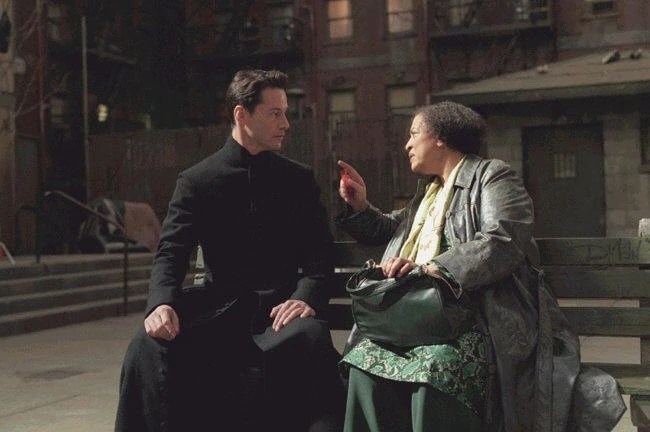

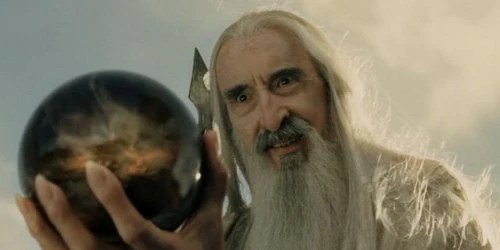
Gandalf. Galadriel. Rafiki. Sean Maguire. Yoda. Hermione Granger. The Oracle. Mr. Miyagi. Uncle Iroh. The magician is everywhere in our modern stories and films. Sadly, the magician at its full potential often seems exiled to such stories and given little room to exist in our modern world, to the detriment of us all. For starters, however, let us quickly recognize the magician’s gifts that he or she uses when engaging in catalytic work.
The capacity of magicians to heal, transform, and regenerate both individuals and communities rises from an unwavering commitment to being co-creators in, and even of, our world. They can be terrifying, especially in an increasingly narcissistic society, as they guide us through the deconstruction of our egos and force us to come face-to-face with the harsh reality that we are often more driven by our own grandiosity rather than generativity. Adding to the challenge of the magician is the presence of shadow magicians, who belittle and manipulate others as they strive to maintain their status, authority, and sense of superiority.
The Magician’s Roles


The magician fulfills a variety of roles. Two of these roles are that of a master of technology, revealing power in the physical world, and that of a keeper of various forms of knowledge, granting insight into our personal and collective psyches. The “master of technology” might cause you to raise an eyebrow, so let us start there. Yoda and Obi-Wan Kenobi are masters — both in using and understanding — lightsabers. Hermione Granger expertly utilized the Time-Turner in “Harry Potter and the Prisoner of Azkaban.” These science-fiction and fantasy references may seem to have little to do with the “real world,” but the magician acts as a co-creator in and of the world. We live in an age where the master of technology aspect of the magician is on full display as technological advancements are made at a dizzying pace. All the while, the magician as the keeper of unique knowledge that allows him or her to guide people through the nonmaterialistic, psychological, and spiritual world is not just being lost but actively pushed to the wayside.
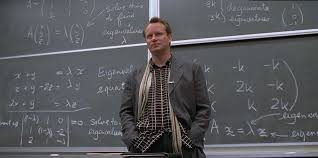

Sadly, I can offer my own profession of teaching as an example of this. Education increasingly seeks to seemingly prove its worth and productivity through data-driven decision making, as if creating self-serving and deceptive metrics will reveal much growth at all. All the while the inner worlds of students, already neglected by society, are largely underappreciated by schools. Granted, your school system can show you a checklist of programs designed to address this issue, but shadow magicians have little interest in actual results, for they are too busy manipulating others in an effort to maintain their status, authority, and a sense of superiority. A shadow magician can create a great deal, just not anything that guides a person to true authenticity. Alienation and pretense are the realm of shadow magicians. If you have ever been in an environment that dampened your creativity and demanded conformity at the cost of psychic authenticity— which seemed to stunt growth —you have been in the presence of a shadow magician.
Our Fractured World
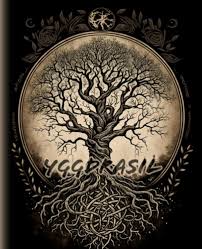

Yggdrasil, the world tree of Norse mythology. Rafiki’s sacred baobab tree in “The Lion King.” The Oracle’s kitchen in “The Matrix.” All of these are examples of the Axis Mundi, a world axis that connects heaven to earth. It acts as a central space from which people can orient themselves. A place that communicates the existence of a true center and, therefore, can challenge all to find their psychological and spiritual core. These are profound sacred spaces.
In our world, the concept of such a central space is viewed with derision and intellectual disdain when not simply politely ignored. The modern world embraces and reinforces profane space, which has no true center. This does not, however, prevent people from seeking one, as the archetypal pull of the Axis Mundi is unmistakable. People seek these spaces that do serve the function of creating a sense of community while simultaneously deepening our divisions.

Some seek their true center in political parties, railing against the actions of the other party while turning a blind eye to the frailties within their own. Democrats create jargon and phrases that act as litmus tests for the adherence of their “believers.” The party of inclusivity using language to exclude others for if one rejected, or did not know, these phrases, they were belittled and mocked while status was protected — marks of the shadow. Republicans raise blind loyalty to the party and power to be the measure of devotion. The party of individualism rejects the magician’s call to individual growth. The weakening of the ego in the name of true transformation, is anathema to shadow magicians who are convinced they know the way.
These two examples do share common ground; they do not offer a fixed point where people can center themselves. The party will tell you what and where that “fixed point” is, and you should just follow. Many professions likely adhere to the same hidden principle, even as they profess to be “a calling” or encourage employees to be “good team members” or parts of “the family.” Thankfully, while this happens, people’s psyches crumble and they feel disconnected from work, culture, and themselves.
Wait! Thankful for WHAT?!
Thankfully, while this happens, people’s psyches crumble and they feel disconnected from work, culture, and themselves. Yup, that’s what was written. Yes, it was. Eventually, if forced to eat sand that you are told is a fine stew, you may reject the sanitized and scripted role foisted upon you and seek your own authenticity and soul. Initially, that may take the shape of momentary escapes like weekend getaways and vacations. This does allow for a sense of regeneration, but not spiritual and psychological transformation.


Consider this scene from “Bucket List.” Billionaire Edward Cole (Jack Nicholson) and mechanic Carter Chambers (Morgan Freeman) meet in a hospital as they both suffer and struggle with cancer. They go on a globe-trotting trip together, fulfilling desires on their bucket lists. When they return to the United States, Carter attempts to orchestrate a meeting between Edward and his estranged daughter. In a rage, Edward exclaims, “…and I am supposed to make out like what, this trip was supposed to mean something to me? Like it was gonna change me!?…This was supposed to be fun.” Still, Edward eventually follows Carter’s prodding which allows for a reconciliation, the creation of a relationship with his granddaughter, and these words at Carter’s funeral: “He saved my life. And he knew it before I did.”

Edward had his worldview — the view that drove the creation of his business — crumble before him. As it happened, he had a guide, a true magician, to initiate him into a new world where his true center could be found. As Edward said, “I hope this doesn’t sound selfish, but the last months of his life (Carter), were the best months of mine.” This theme of destruction leading to transformation and healing, the rising phoenix, is an archetypal one — and linked to the power of the magician.
The Importance of the Magician
Carter utilized the energy of the magician to heal and transform Edward. It is important to note that Carter did not force the change. The wise magician realizes and accepts the harsh truth that people must take their own journey for true transformation to occur. The shadow magician controls and dictates; the magician guides, encourages, and remains patiently hopeful. Carter is also fulfilling the ritual leader role of the magician, someone who can skillfully guide a mentee through the initiation process into the larger world. This process can, of course, look disturbing when performed by the shadow magician.


Even a quick assessment of Scar from “The Lion King” will illuminate this conversation. In many ways, he is the shadow magician, haughty and superior. He also taps into the transformative powers of the magician, for he does transform the Pride Lands — he just transforms them into a burnt-out, barren wasteland. Still, despite the evidence all around, he declares himself “Ten times the king Mufasa was!” Never underestimate the blinding power of denial and delusion.
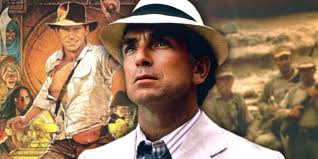

Reaching back to my childhood, let’s examine Rene Belloq from “Raiders of the Lost Ark.” He attempts to perform a sacred ceremony to unleash the power of the Ark, his ever-present arrogance oozing from his pores. He dresses in ceremonial garb and recites all the correct prayers, as if the trappings of a devout member of a religious and spiritual tradition can conceal his fundamental pomposity. Ritual without soul. Prayer without discipline and devotion. His surface-level manipulation becomes his downfall as the spirits of the Ark recognize that a shadow magician, a profane man, is seeking to utilize the sacred for selfish purposes.
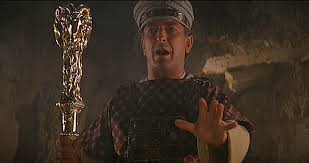


They lash out and kill Belloq and all the Nazis present. They melt Arnold Toht’s face (take that, Gestapo!). While Indiana Jones tells Marion to close her eyes and not to look at the Ark, I do not think the simple act of closing their eyes spared them. The closing of their eyes is an act of humility; they do not look upon something not meant for them. Also, they are not seeking power for themselves. While neither Indy nor Marion are magicians, the wisdom of the spirits can discern the enemy of the soul from a cynical seeker.
Shadow magicians may reign for a time, but their shadows always threaten to consume them even as they, sadly, damage others. But the plains around Pride Rock can become green again. The cynical seeker learns to appreciate the power and mystery of the Ark. The magician may even find a role in these quieter times as well.
Magician as Co-Creator
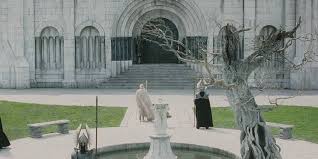
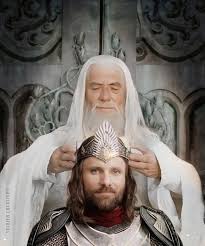
“These are the days of the King.” So spoke Gandalf as he placed the crown of Gondor atop Aragorn’s head. The war was over and the future beckoned. Aragorn was transitioning from victorious warrior to peacetime king. Gandalf oversaw the ceremony, the white tree of Minas Tirith flourishing again (the Axis Mundi). It was Aragorn’s world to rule now, and Gandalf would step back. The efforts of so many united to save Middle-Earth, with Gandalf playing his part as co-creator, not sole savior. White knights never ride alone.

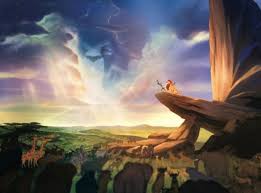
The same dynamic plays out at the end of “The Lion King.” Rafiki, who has already brought Simba to his meeting with the spirit of his father, Mufasa (a catalytic event), and helped him process the encounter (healing), now encourages Simba to ascend Pride Rock (the Axis Mundi) and take his rightful place as King of the Pride Lands. The circle of life completes a turn and starts another, where new magicians will rise, shadow magicians will rend communal and individual souls, and, perhaps, the ever present pull of true magicians can help bring about healing and transformation, allowing a new community to rise.
Lessons from Magician Miyagi
Time-traveling teenage wizards, experienced sages protecting retreating forces from the Nazgul on the Pelennor Fields, or “Dragon of the West” using his Sozin’s Comet power boost to help liberate Ba Sing Se are entertaining and even iconic. They can, however, seem quite distant from our worlds, leaving the idea of the archetype of the magician an element of fictional writing, inaccessible and disconnected from the practical and limited reality of our lives. To dissuade us from this notion, let us close with insights offered from Mr. Miyagi, the magician of “The Karate Kid.”
Let us start with the mythical element of the Axis Mundi. The word myth is used with great intentionality in the previous sentence. Modern people often think myth = false. This is, in fact, a faulty concept. The fourth- century philosopher Salustius noted, “Myths are things that never happened but always are.” In our modern world, we sometimes create personal sacred places that are not a true Axis Mundi but can be regenerative and healing in their own right, like Miyagi’s backyard/training area where he revealed the larger world in the famous “show me wax on, wax off” scene.
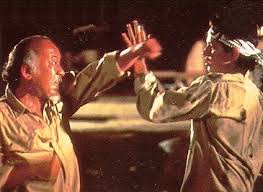

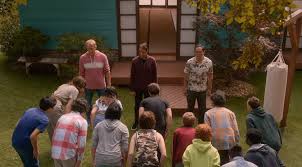
This personal sacred space becomes his dojo in the Netflix series “Cobra Kai.” It is here that he teaches Miyagi-Do karate to a new generation of students. It becomes a place where Daniel and his students find renewal after setbacks and centering when confused. Where Miyagi slowly and patiently initiated Daniel into a larger world, Daniel now performs the same function for his students. Miyagi was focused only on his time with Daniel, immersed in the powerful present. With no regard for legacy, he created one. With no concern for acclaim, he became treasured. What was once a place for a singular teacher and student has become a larger community, nourished by the patience, wisdom, and humility of a man who sought the depth of the present and, in so doing, expanded himself into the future, even after his death. Something special took root in that space. Something real, that reductionist thinking would try to wipe away and Daniel would quietly smile about, knowing the power of the place and the way it transformed his life.

I wonder, can you see aspects of your life in this? Are you, perhaps, stressed when trying to create the desired outcome rather than doing all you can in the present moment to develop the elements to make the outcome more likely? Do you guide your “Daniels” while realizing they must fight their own battles? Do you stand as a supportive force on the edge of despair or do you chastise them for not realizing all you’ve done on their behalf? Can you create space to be the patient guide while the world around you demands more speed and scripted outcomes? Perhaps most importantly, can you accept the fact that your own imperfections and failures may well make you the perfect magician?
The Perfectly Imperfect Magician
Many archetypes exist, and it is our capacity to integrate them into a cohesive whole that is essential to Jung’s individuation process. This ongoing, iterative cycle allows one to become a unique individual. Even your flaws, failures, and shadows synthesize with their opposites to create the grand kaleidoscope of authentic selfhood. Again, we can look to Miyagi as our guide.


In a scene that begins humorously and becomes, to say the least, melancholy, Daniel makes an unexpected visit to a drunk Mr. Miyagi. While the scene includes Miyagi striving to teach Daniel to exclaim the toast, “Banzai,” it becomes a drunken lament, for this is the anniversary of the deaths of his wife and child due to complications in childbirth. Miyagi passes out and Daniel departs, his humanized mentor resting under a blanket his student placed upon him.
The suffering redeemer is a powerful archetype in the Jungian worldview. Such people have suffered and will always carry the memory of that pain. The experience has not, as it all too often does, made them bitter or dismissive of others’ trials and grief. Rather, it makes them sympathetic and empathetic. It enables them to stand firm with another who is standing in their personal abyss because they have integrated their heartache into their unified psyche. A mature magician who is also a suffering redeemer is indeed a legendary mentor.


Do you allow your imperfections to be sources of shame, or have they become the weights that build psychic strength and resilience? Are you, perhaps, impatient with others because they remind you of your own flaws, causing you to lash out at the “problem” before you when the true challenge is the demon within? Do you hold yourself to a standard that you would never hold a best friend to?
If this is the case, befriend yourself — or at least strive to be kinder to yourself. Perhaps in doing so you will awaken the magician within and transform your life. Your capacity to assist others transform theirs will grow exponentially. Perhaps you can bring healing and unity to your piece of our fractured world and help a sense of wholeness to grow. It does not have to be grand victories over Lord Voldemort or Sauron. Helping yourself and others find the balance, just as Miyagi taught Daniel, will be glorious!


 james-rourke-author.com