
The Bruce Springsteen biopic Deliver Me From Nowhere was released in the United States on October 24, 2025. To no one’s surprise I took it in on the opening weekend. The film does not attempt to recreate Springsteen’s high energy concerts or present him as a mythic rock and roll icon known around the world as The Boss.
No, this is a story of a man in crisis. A man battling to stabilize his trembling psyche with the best weapon at his disposal, his art. It’s about the power and necessity of male friendship. It’s about how obsessive the artistic drive can become and, conversely, how slow and disjointed healing can be. That man just happens to be Bruce Springsteen.
Spoiler Alert!! Proceede with caution!
My Father’s House
My father’s house shines hard and bright
It stands like a beacon calling me in the night
Calling and calling so cold and alone
Shining ‘cross this dark highway
Where our sins lie unatoned (1)

The film wastes no time putting us in the middle of Springsteen’s complicated and abusive relationship with his father, Douglas. A young Bruce is sitting with his mother, Adele, in a parked car. She instructs him to get out and retrieve his father from the bar (2). This is but one of the flashback scenes that highlight the impact this brooding, alcoholic, and distant man had on Bruce. The boy trembles before his father and his mother struggles to hold the family together, her frustration boiling over in explosive arguments and bitter tears.

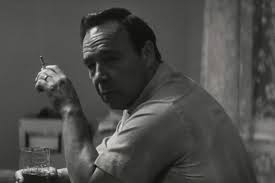
These flashbacks are dispersed throughout the movie, reminding us that these emotional memories are woven into Bruce’s soul. Each step he takes and each chord he strums has the potential to be haunted by these visions rising from their internal resting places like ghosts from a tomb. Some viewers may find the narrative of the film being interrupted in random intervals by black and white scenes distracting or discombobulating. On the other hand, my depressive episodes – which included intrusive thoughts – never seemed very concerned about intruding at inconvenient and unexpected times. Depression isn’t polite.
Darkness is Everywhere

The film focuses on a very specific time in Bruce’s life, the creation of Nebraska. This stripped down, introspective and somber album explores themes of loss, desperation, and alienation. The characters in these songs range from criminals to shattered members of the working class. Three songs are directly pulled from Bruce’s childhood experiences. Images of dead dogs, abandoned grooms, and the desperation caused by debt are among the uplifting pictures painted in the lyrics of Nebraska’s offerings.
Kevin Slane, a movie critic who covers entertainment and culture for Boston.com states that “Deliver Me From Nowhere feels like being stuck in a low-grade depressive episode…” While I understand such a cinematic experience isn’t for anyone I thought it was perfect. Perfect because the tone of the film created the mood Bruce was experiencing the entire time! As someone who struggles with depression I found director Scott Cooper’s ability to make depression a constant presence in the film powerful and oddly refreshing.

Like anyone struggling with a psychological disorder and mental health issues, Bruce had some moments that were worse than others. While some scenes are lighter, the tone rarely feels relaxed or casual. Depression is often unrelenting and heavy. It can consume or, at the least, taint even good moments. That this film was able to imprint that fact within the narrative was a victory. A victory, mind you, for director Scott Cooper. At various times it decidedly does not feel like victory for Jeremy Allen White’s Bruce Springsteen! So, what’s an anguished song-writer to do? How does he get through?
The Creative Drive

Bruce’s creative intensity, and the purpose it provides, keeps Bruce functioning. Bruce’s capacity to write lyrics, compose the musical compositions, rewrite, reimagine, and do it all over again actually presents another challenge in the film. Bruce’s isn’t falling apart wholesale. He is slogging, slugging, struggling, and living. Again, the tone of Deliver Me From Nowhere allows viewers to be reminded of this even as he frenetically pushes himself to complete Nebraska and for the studio executives to accept an album that lacks clear commercial appeal.

Bruce’s restlessness is communicated through late night visits to the legendary Stone Pony. His conviction finds voice in his unrelenting commitment to the unvarnished sound and structure to the songs that make up Nebraska. His decision to shelve more marketable material (Born in the U.S.A. and I’m on Fire) leaves music executives in their offices and the audio and recording engineers in the studio frustrated and confused.
This brings us to another important aspect of the film as the creative process does not heal Bruce. Purpose keeps him going. Sometimes creativity is a form of coping, at other it is an escape. The thin line between healthy and unhealthy investment gets blurred but embracing his art does allow for progress. He does not, however, complete the album and, by staying true to his artistic vision, defeat his depression. This is not a fairy tale and that is not how the mind works.
A Reason to Believe

The relationship that exists between Bruce Springsteen and Jon Landau is central to the unfolding drama. It is a fine example of not only friendship, but the importance of belief. Jon does not initially understand the direction Bruce’s creativity has taken him. As his manager he presents Bruce a variety of professional opportunities, all of which are dismissed in favor of completing Nebraska.
A beautiful moment in the film is when Jon Landau declares, “In this office, we believe in Bruce Springsteen.” Again, Jon doesn’t understand what is driving Bruce and, more importantly, he doesn’t pretend to possess this insight. Jon talks with Bruce and articulates some ruminating conclusions during conversations with his wife but he never is presented as someone who completely grasps what Bruce is experiencing. Instead he follows his belief in his client and friend, lending his full support to something he doesn’t completely see. He even supports Bruce’s demand that the album lives on its own merits. No tour. No singles. No press appearances. Professionally, Jon was…let’s say…surprised and a touch concerned about this news. Personally, well, he believes in Bruce Springsteen. What a rare and wonderful gift.

As the film approaches its conclusion Bruce’s mental state is again deteriorating. He reaches out to Jon. After a brief conversation Jon admits that, while he has helped Bruce through hard times he is not equipped to guide him through this. He is not being dismissive. He is humble. Humble enough to be honest with himself regarding his limitations and, by extension, honest with Bruce as he guides him to find a therapist. Humility as a source of power. How many films have you watched that effectively portray that?
See Ya Next Time

See ya next time. I’ve heard Bruce declare that at the end of a concert or two. I’ll be writing another post at some point so I will “see” all of you next time as well. Until then follow your vision, even if the road gets rocky. You might be surprised where you end up. Seek help when needed, it pays off in the long run. Lastly, consider the power of humility. Not only does it make it easier to accept help, it makes you more capable of offering aid and authenticity. Maybe our hearts would be bigger if our egos didn’t take up so much space.
Endnotes
(1) “My Father’s House.” Springsteen, B. Nebraska (1982).
(2) Bruce tells this story during his acclaimed special “Springsteen on Broadway.”


One thought on “Deliver Me From Nowhere: A Study of Mental Health Through Music”