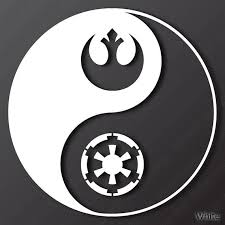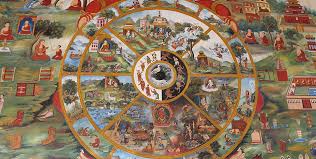
A simple understanding of dukkha is as the anxiety, restlessness, or distress that arises when life feels out of sync. The First Noble Truth of Buddhism states that suffering is an inevitable aspect of life, which means we all experience dukkha. The Second Noble Truth informs us that the cause of this suffering is attachment. Thankfully the Third Noble Truth assures us there is a way to be free from suffering: by breaking our attachments. This is a profound challenge but, as The Last Jedi demonstrates, it is possible – and when accomplished the path to peace and purpose becomes clear.
In The Last Jedi attachments bring a great deal of suffering to several characters. Kylo Ren, Rey, and Luke Skywalker are all fettered to beliefs and mindsets that lead them into painful situations, even when the opposite is sought. There is, of course, hope – there’s always hope in Star Wars – of breaking these attachments, as Master Yoda proves in his cameo appearance.
The Eastern Ego in The Last Jedi
The ego, as understood in western psychology, is a necessary aspect of our psyche – something that must be strengthened to enable a person to develop the skills to navigate the storms of our lives with relience, strength, and compassion. In contrast stands the eastern concept of the ego; a part of the psyche to be transcended. In Buddhism, though the concept rings true in Taoism as well, the ego os the part of ourselves that seeks separation and dominion over others. While promising power in usually delivers isolation.
In The Last Jedi, three characters are symbols of isolation. Either through their words (Kylo Ren and Rey) or self-imposed exile (Luke Skywalker), we experience how alone they have become. All three are fettered by attachments they cling to despite the ruin their grasping brings into their lives.
Kylo Ren’s Rage
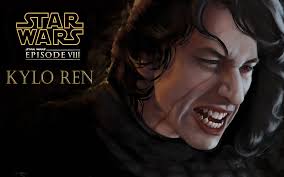
Kylo Ren represents a devastating misunderstanding of what it means to let go of the past. Repeatedly and emphatically, he insists that freedom can only be found by abandoning the shackles of the past. In Kylo’s mind, liberation means letting the past die – even killing it, as he says on more than one occasion.
His words carry a hint of truth. Remaining chained to a past that prevents growth is destructive. To free oneself from such chains is spiritually and psychologically liberating – just ask Ebenezer Scrooge.
Unfortunately, we communicate with much more than words. Kylo is an engine of rage, and while some of his words ring true, the emotional fuel driving him is akin to drinking poison while hoping another will die. He is consumed by anger, and so his desire to break free from the past becomes twisted into a desire to destroy and dominate.
Even replacing Snoke as Supreme Leader does not satisfy him. Of course it does not. Dethroning Snoke merely creates an opportunity to act upon his desire for domination .
His anger does not lead to peace but, rather, feeds his ego. He seeks power. He seeks dominion over the galaxy. He has not freed himself of the past at all. In fact, his anger only deepens his war with his it. His anger has not liberated him, it has bound him.
He is walking the path of Vader, which only leads to isolation and frustration. This becomes painfully apparent as he kneels in the ashes of his failed attempt to crush the rebellion and experiences the anguish of Rey shutting their Force connection. Breaking from the past through anger alone brings only bitter fruit.
Jedi, thy name is Hubris!
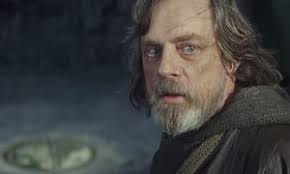
Luke Skywalker is one unhappy fella in The Last Jedi. He expressed his own frustration by denigrating the hubris of the Jedi. Darth Sidious rose to power by carefully planting the seeds of The Empire with a meticulous plan that unfolded right beneath the Jedi council’s collective noses. The Jedi masters, including Yoda, were blinded by self-righteousness born from their many successes. In Taoism, however, we are taught that success can bring about great trouble.
Anger is frequently referenced in Star Wars as a key step on the path to the dark side. The Jedi, however, seem cursed with a different burden: hubris. Luke, echoing Kylo Ren’s desire to break from the past, speaks words that contain genuine truth. The Jedi were blinded by hubris – and so is Luke.
He cannot forgive himself for failing Ben Solo (Kylo Ren). In many ways this is a form of arrogance. Where is it written a teacher will, without fail, reach all their students? Such immature martyrdom often accompanies noble intention unrestrained by humility. Much like Qui-Gon Jinn, who defied the Jedi council to train Anakin, and Obi-Wan, who believed he could train Anakin as well as Yoda, Luke suffers because of his own hubris.
His pain is made worseby the deaths of his students and the sense that he let down both Leia and Han. Luke attempts to atone by transforming his past into a weapon with which to bludgeon himself and the legacy of the Jedi. Yet peace is rarely found in self-flagellation. More often, it binds a person to an endless wheel of suffering. In both anger and hubris we see dukkha rising.
Rey, you are a Jedi!
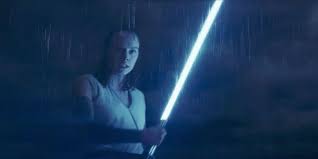
Supreme Leader Snoke mockingly identifies Rey as a true Jedi because of her “spunk” and spirit. She also embodies Kylo’s rage and Skywalker’s hubris. Her anger is evident to anyone who has watched the films. In battle her facial expressions and ferocious snarls rival any character known for channeling rage into combat. Daisy Ridley communicates this deep reservoir of anger with remarkable intensity. Sadly, hubris is present in Rey as well.
Convinced by Snoke’s manipulation that Kylo Ren can be turned from the Dark Side of the Force she attempts to save him. Luke warns her that the path she is choosing “will not end where you think it will.” She chooses to dismiss him. After all, what could Luke Skywalker possibly know compared to someone trained in the ways of the Force for roughly a week?
Granted, Rey has an extraordinary natural connection to the Force. Who needs discipline, training, fundamentals, and technique when you’re a naturally gifted with raw talent? With hubris like this Rey is personifying the crippling weakness thay all but destroyed the Jedi. She may even be from the United States instead of Jakku.
Don’t forget Snoke
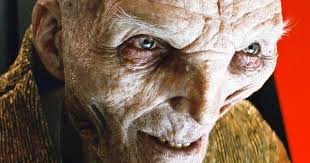
Before moving on, it is worth noting that hubris ultimately brings about the downfall of Supreme Leader Snoke. Despite – or perhaps because of – his immense mastery of the Force, Snoke does not “see” what Kylo Ren intends. As he mocks Rey for believing Kylo can be redeemed, he praises his pupil for the strong resolve he senses withinin him. Kylo, Snoke boasts, has cast aside doubt and is prepared to strike down his enemy.
Smoke was correct on all three counts: Kylo is full of resolve, has cast aside doubt, and is ready to strike. Snoke simply could not see the true target. Nothing like a little too much prideto initiate the fall.
The brilliance of the scene – which cause full audience cheers during my second sitting – was that Kylo was merely paving the way to the throne. He covets power, not peace. The audiences’ cheers quickly turned to boos, and my daughter asked, “Wait…but…what side is he on?”
I told her, “His own. Keep watching.”
Of course Kylo is on his own side. As we have seen, the ego leads to isolation. Be careful where your attachments lie; you only get what you grasp.
Master Yoda and Forgiveness
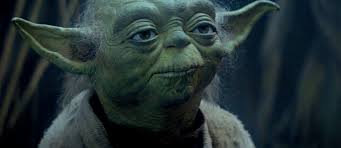
When Rey leaves Luke on his island, he decides to burn the tree containing the sacred Jedi texts. Yet, despite giving a determined explanation, Luke hesitates. To help his former student, Yoda summons a bolt of lightning and sets the tree ablaze. Luke is horrified. Yoda is amused.
Chapter 20 of the Tao Te Ching suggests that a person living from the Tao may appear foolish to others – depending on the translation they may seem stupid, lost, dimwitted, dull, confused, and ignorant – because they laugh at seemingly inappropriate times. Or, in Yoda’s case, a fool…laughing as the sacred tree burns.
The moment reminds us of Luke’s own words, “The Force doesn’t belong to the Jedi.” Yet even as speaks those words, he struggles to accept the truth Yoda’s actions brought to life.
This is a lesson in breaking attachment. Despite his words Luke was still attached to the tree and the sacred texts. He was not prepared to watch them burn. Yoda’s destruction was not from anger, but from love and wisdom. He understands Luke was correct: the Force does not belong to the Jedi. It exists beyond themw, sustaining the harmony of life itself. Surely it can survive the burning of a single tree.
The lesson is not over. Yoda then confronts Luke’s sense of failure. Ironically he does so by reassuring Luke that he did, in fact, fail. No doubts about it. So did other Jedi. So has Yoda, himself. But failing does not make one a failure – that’s just another false attachment.
Failure can be a fierce but worthy teacher if one has the strength to allow its lessons to unfold. Yoda became the humble teacher we encounter in The Empire Strikes Back precisely because he first walked the false path of hubris and suffered the consequences in Revenge of the Sith.
When hubris fades – struck down not by rage but by self-forgiveness – peace begins to rise. Acceptance of both self and others follows. Such calm creates strength that anger can never replicate.
I wonder if Rey, having confronted her hubris at such a young age, will become a peaceful warrior by the end of episode IX. She is on an promising path, having been humbled by hubris but, unlike the isolated Kylo Ren, surrounded by friends and allies who genuinely care for her. Friendship triumphs over isolation. Forgiveness transforms failure. The breaking of false attachments brings peace.
Perhaps by burning a sacred tree reveals that life itself can become a sacred dance when we find ourselves in harmony with the Force. Wouldn’t that be something?