

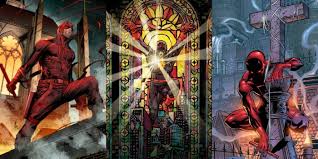
Daredevil: Born Again released the final episode of season 1 on Tuesday, April 15. Such perfect timing for one of the few overtly religious characters in the Marvel vault (1). Matt Murdock (Daredevil) is a devout Catholic and a lawyer, meaning his vigilante activities puts him at odds with both his religious convictions and professional ethics. It is no accident that Matt chooses to dress as a “devil” when adopting his heroic alter ego. He is well aware of the darkness within that he taps into in order to battle the dark forces of the world. This paradox causes him great personal turmoil, and what could be more Catholic than that (2)?
Religious Literacy and the Psychology of Faith

Matt’s religion presents a challenge when analyzing him, his actions, his motives, as well as his reaction to the motives and actions of other characters. This challenge is best explained as religious literacy. Problems that arise from religious literacy (or illiteracy as the case may be) include stereotyping of religious people, failure to appreciate (or even consider) the metaphor, symbolism, and nuance in religious texts, the failure to understand the interval diversity within religions, and the inability to grasp that religion and science are compatible. To be clear, both religious and non-religious individuals can struggle with religious literacy. While I do not wish to spend an inordinate amount of time on this topic I do believe in setting a clear vision for our evaluation of Daredevil.
Speaking of belief, let’s make it known far and wide that (A) Belief ≠ Faith and (B) Belief in a religious context ought to focus on concepts far grandeur than whether or not Jesus walked on water, the Buddha could levitate, or Lao-Tzu rode on the back of a bull into his secluded retirement in the mountains. In an earlier post regarding faith I utilized Hershel from The Walking Dead to introduce James Fowler’s theory regarding the psychological development of faith (https://james-rourke-author.com/2017/11/27/seeking-faith-among-the-walking-dead/). Fowler’s theory includes six stages and five transitional corridors which a person may go through.
Religion and Ontology
Ontology is the philosophic study of, and inquiry into, the nature of existence. Religions, at their core, introduce an ontological map of reality. IF someone’s faith develops into the fifth stage, enduring the crucible of stage four and the four-to-five corridor, this ontological map becomes something the individual “suspects” is the underlying foundation of reality and they try to “stay attuned to those patterns” (4).
So, what does any of this mean in the real world? It’s quite simple, actually. To a Buddhist, karma would be an ontological reality. Now a stage three Buddhist likely could quote some important passages regarding karma but may, in ways large and small, not live as if it really mattered. A stage five Buddhist, who suspects the ontological reality of karma, would likely live differently as they attempt to “stay attuned to those patterns.”

Now, even a rudimentary knowledge of karma allows one to see how karma is the moral law woven into reality itself. The idea that karma exists as a moral law brings us to the concept of meta-ethics. Within moral philosophy there are two camps under the umbrella of meta-ethics. You can not be in both and there is no Venn diagram allowing for overlap. Every person eventually comes to believe that morality either exists as a part of nature (karma, god’s law, etc.) or is projected into the world by people (laws, ethics, customs).
These two camps are called moral realists (morality, like gravity, is part of the universe) or moral non-realists (morality, like love and courage, exists as something people bring to the world). If the human race ceased to exist morality would still exist according to moral realists and cease to exist according to moral non-realists. Let’s assume that karma exists. If karma exists that means we live in a moral universe. Does the phrase “moral universe” ring a bell for you? I’ll give you a second to dust off your educational cobwebs. Time’s up.
What’s Up, Doc?
Dr. Martin Luther King jr. once stated, “The arc of the moral universe is long but it bends toward justice” (5). King, a Southern Baptist minister, is presenting a message of hope and patience to his listeners. He is also presenting a glimpse of the theological concept of a providential universe, with morality woven into reality and free will allowing for people to work at finding that arc and working to hasten the arrival of justice (attend to the arc) or deny and work against universal justice.

Matt Murdock, like King, is a Christian. He is written as a Catholic while King was a Southern Baptist, but both exist under the umbrella of Christianity. King is a historic figure who strove to live by the demands of the moral universe, which adds context to his embracing of non-violence as a way of life whereas other civil rights activists, like Stokely Charmichael, view non-violent action as a tactic. Matt Murdock would, undoubtedly, admire King’s non-violent stance but he does not live it. His Catholicism does, however, shape his activity on the roof tops and in the court room.
As noted, the providential universe with its “arc towards justice” is one aspect of the Christian ontological map. A second ontological aspect of Christianity is also posited by other religions.It is the idea that deep within each person is a soul or conduit to the divine that grants value to each individual. The fact of your existence means you have value. Socio-economic level, race, sex, gender, intelligence, physical strength, political affiliation, etc. has no bearing on your true value. The blooming idiot and the wise sage both carry this “soul” and it is incumbent upon Matt (as a Catholic) and Dr. King (the Southern Baptist) to treat them as such. Of course, not everyone shares this conception of human nature.
Matt and Frank

Frank Castle (The Punisher) exists as an intense foil to Daredevil. In a classic episode of Daredevil (season 2, episode 3) engage in a philosophic and ideological debate on a rooftop. To be sure it is an unusual debate for a couple of reasons. One, Matt is chained to a chimney. Two, Frank hits his debate opponent in the head with a gun, rendering him unconscious, because he gets frustrated with his answers. Not exactly high school debate club procedures.
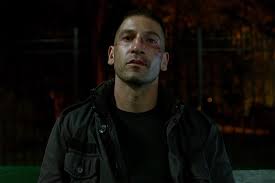
It is in this episode that we are privy to our fullest glimpse of how Matt reconciles his Catholicism with his actions as Daredevil. Frank has zero compunction when it comes to killing, defiantly stating, “I think that the people I kill need killing, that’s what I think.” When Matt protests by pointing out Frank left men hanging on meat hooks Frank doubles down by responding, “They got off easy in my opinion.”

Their conversation continues as Matt eventually asks Frank if he ever doubts himself. Frank, naturally, does not. This brings Matt to express his doubts about Frank, “Really? Really? You never think for one second, “shit, I just killed a human being.” Frank’s retort – “That’s being pretty generous” – gets to the core of their ontological convictions. Frank views the value imbued in the title “human being” as something you earn (8).
Matt’s Catholicism pours from him as he answers, “A human being who did a lot of stupid shit, maybe even evil, but had one small piece of goodness in him. Maybe just a scrap, Frank, but something. And then you come along, and that one tiny flicker of light gets snuffed out forever.” Everyone, for Matt, has “one small piece of goodness” in them (the soul). This does not prevent them from doing “stupid shit, maybe even evil…” but it does mean that they deserve an opportunity, in Matt’s words, “to try again.” Here Matt digs deeply into the Catholic conception of redemption. We will return to that idea in due time, but first we need to break Matt’s spirit a bit more.
Stupid Shit, Maybe Even Evil…
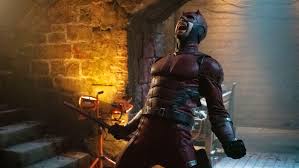
As the first episode of Daredevil: Born Again comes to a close we witness Daredevil toss the psychopathic assassin Benjamin Poindexter (Bullseye) off a building. This was not done to render Bullseye incapable of fighting. It was an attempt to kill the man who had already murdered “Foggy” Nelson (Matt’s best friend) and Father Paul Lantom (a Catholic Priest and mentor). Poindexter also suited up as Daredevil for a time in an effort to ruin his reputation.

Despite an ever growing list of victims (including the two people dear to him) Matt is wracked with guilt over his attempted murder. The fact it didn’t succeed does not matter, the intention is real and Matt does not deny this reality. Nor can he deny that he had once told Frank it is not a vigilante’s call to end a life. Having broken his deepest held code Matt abandons his vigilante persona, not only as penance for his act but fear of his inability to control his violent impulses. He, undoubtedly, believes he has moved from doing “stupid shit” to “evil.”
Matt, as we have already stated, is an ardent Catholic so the fact he acted on a murderous intention cuts him to the core. As we have already noted, aspects of Catholicism are the moral realism of the universe and the existence of an internal aspect of the divine. There is a third aspect of Catholicism (and all religious traditions) the utilization of stories to teach moral lessons and offer a framework for approaching life (9).
The Old Wooden Cross

Christian and Biblical scholar Marcus Borg teaches that, in ancient times, Christians were referred to as “Followers of the Way.” Christianity at its roots, therefore, isn’t about beliefs, miracles, adhering to dogma. It is about living a particular way, the way exemplified by Jesus of Nazareth. If Father Lantom was alive in Daredevil: Born Again I wonder if he would have counseled Matthew by reminding him of another way that he was already walking, The Way of the Cross.

The Way of the Cross is central to the Catholic Easter celebration and also acts as a framework for approaching life. It is a familiar Way for Matthew, though a reminder may have helped him navigate his shame and guilt (10). There are fourteen stations on this Way (fifteen if the resurrection is included) all of which are relevant to Matthew’s life.
Challenging Powerful Forces

Station 1: Jesus is condemned to death. Two powerful and connected forces, the Sanhedrin and the Roman government in Judea, condemn Jesus to death, It is important to note that the Jewish community during the Roman Empire were divided into four groups – the Sadducee, the Pharisees, the Zealots, and the Essences – each with different visions of their faith and how to endure Roman rule. The Sadducee were the most political and thought working with Rome was the best bet. They also had the most influence in the Sanhedrin, a Jewish legislative and judicial council with tremendous authority regarding internal legal matters.
While Matt isn’t formally sentenced to death he does stand up to and before powerful people (Wilson Fisk and Alexandra) and organizations (Fisk’s criminal organizations and The Hand). These groups, without a doubt, want him dead and detest his interference in their business.
Life is Pain!
Station 2: Jesus takes up his cross. In this station the cross is a symbol of suffering…and rightfully so! The Romans used crucifixion to publicly torture and execute criminals, disloyal soldiers, foreigners, and Christians. Poles and even trees as well as crosses were utilized in this brutal form of capital punishment. In the stations it is a reminder that life can be challenging and filled with pain. No one is escaping life without wounds. The stations’ wording, Jesus takes up his cross, can be viewed as misleading because he didn’t take up the cross so much as it was forced upon him. However, a small step into metaphor reminds us that while the cross was assigned to Jesus he quite willingly, in his early 30’s, took on the role of social agitator and religious trailblazer, offering a different path (way) to follow. This brought him into conflict, hardship, and suffering.
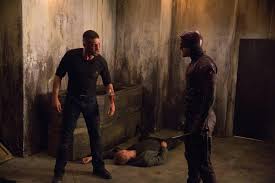
In the aforementioned rooftop conversation between Matt and Frank, Matt makes the claim that it is not his “call” or Frank’s to kill people. Frank’s response, “Did somebody ask you to put on that costume or did you take it upon yourself?”, brings us directly to Matt taking up his “cross.” He chose to be Daredevil. The suffering that came his way wasn’t desired but he is responsible for the choice to live a way that challenged powerful and malevolent people.
Struggling and Falling

Stations 3, 7, and 9: Jesus Falls. During the stations of the cross Jesus is depicted as falling three times. He rises each time. Matt falls and fails on a regular basis. Physical injuries, while serious, are not the only consequences of his falls. Relationships suffer, friendships are strained to the point of ending, trust is lost, and innocent people are caught and even killed in the crossfire. Still, Matt rises every time, continuing to struggle for the improvement of the citizens of Hell’s Kitchen and New York.
Sharing the Suffering
Station 4: Jesus meets his mother and Station 6: Veronica wipes Jesus’ face. Jesus takes a backseat in his own story in these two stations as Mary, his mother, and Veronica step forward. Station 4 is a sad scene that reminds us that multiple emotions can and often do compete for primacy during our lives. Mary greeting her son is a moment of deep love, shared pain (both physical and emotional), unyielding support, and helplessness we sometimes feel when a loved one is suffering.
Station 6 depicts Veronica coming from the crowd to wipe Jesus’ face. The scene reflects the human desire to do SOMETHING to alleviate another’s suffering. If we are honest, Veronica’s action doesn’t make much difference. Jesus is still carrying the cross, still sweating and bleeding, and will still be crucified. If our cynical times could speak they would likely say, “Why bother.” Because compassion can be fuel and acts of humanity, large and small, are my business…not your concern. Give $5 to the charity. Hand a homeless person a sandwich. Strive to help a student understand a concept just a little better. Don’t let what you wish you could diminish what you can do.
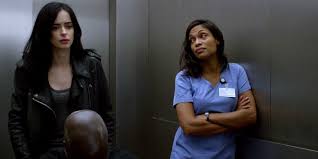
In Hell’s kitchen various characters, primarily women, take on the role of Mary and Veronica. Karen Page, Claire Temple, or his own estranged mother Maggie Murdock, who happens to be a nun…Matt’s life is complicated. All three women have moments of both support and helplessness (Mary) and compassionate engagement (Veronica). In Matt’s world they are able to offer more assistance than wiping his brow as Claire, a nurse, sutures and tends to Matt’s wounds and Karen’s investigative skills and courageous determination helps Matt, even when he doesn’t like it.
Unexpected Assistance
Station 5: Simon helps Jesus carry his cross. In Station 5 Simon emerges from the crowd and helps carry Jesus’ cross. We all need help carrying our crosses, after all Frodo had Sam and even that obsessive loner Batman had Alfred. Simon adds an extra dimension to this idea as he is ordered by Roman guards to assist Jesus. Perhaps they were worried he would die before reaching Golgotha. I doubt it was aid sent from a place of humanity. Simon was an unexpected, but welcome, ally.

Frank Castle and Jessica Jones are but two unexpected allies that arise in Hell’s Kitchen to help Matt accomplish his goals. Jessica, a surly private investigator you met in a previous post, became a trusted ally in The Defenders. Frank, as we have already noted, was a former adversary. As a Catholic Matt must occasionally muse how the Lord does indeed work in mysterious ways.
Of course, in your own life, you likely have a memory or two of aid appearing unexpectedly. The source and timing of these moments are as infinitely varied as our imaginations. Good friends, my kids, valued colleagues, casual acquaintances, students, strangers, former coaches or teachers, and siblings are but some of the people who have filled this role for me. And the timing? Well, that runs from dinner to bars to hallway conversations to shared time in a car. The most important characteristic of it all…openness to the experience.
The Final Fall?
Station 10 through Station 14 depict Jesus’ crucifixion, death, and burial. There is no need to sort out the details here. Sometimes we fall and it feels like/seems like a final defeat. In the Way of the Cross this “final fall” is death itself, but there is also the rising.
Born Again
Station 15: Jesus’ Resurrection. There is an important distinction between the words resurrection and resuscitation. The Way of the Cross leads to Jesus’ resurrection. If the Way ended in resuscitation Jesus would have arisen in the same body, restored to his same state of life and being. Resurrection requires a transformation to a new state of being. In the Gospels this transferred state included the capacity to appear, disappear, and pass through walls. The people he encountered achieved various victories upon seeing him, overcoming doubt, fear, confusion, and earthly power and temptations.
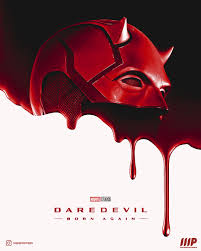
Throughout his fictional life Matt Murdock has been beaten to his knees, nearly killed, assumed dead, and emotionally numbed. Yet in all of these “deaths” he is transformed. Striving to overcome internal and external obstacles slowly, sometimes quite painfully, creates a better version of himself. He is born again (11).
A Final Thought
A well structured world view should embolden adherents to face the inevitable hardships of the world (their crosses), offer them comfort when fatigued, and lead to substantive transformation. What if we could stop worrying about what others believed and spend more time considering two questions. How does my world view aid me? How can I help ease your suffering? Could such questions lead to transformations many seek but few find? I suppose the only way to find out is by contemplating your answers.
 james-rourke-author.com