
Over two millennia ago Socrates emphasized that learning is a form of remembering. While this Socratic rabbit hole can bring us into questions of the nature of reality, I prefer to ground us in the idea of learning, remembering, and forgetting. We will focus on our school systems and, sadly, how they seem to have forgotten much and, by extension, are increasingly incapable of fostering the desire to learn. There is a multi-dimensional pie chart of reasons for this but, for today, I will present the twin ideas that the art of teaching is under siege and the arts themselves are woefully misunderstood as a vehicle for traversing the inner worlds of our students and rekindling the dying embers of curiosity.
A colleague once said, ten years before COVID, that the hardest part of teaching was placing ideas and concepts that you love before your students only to have them reject, dismiss, or belittle them. Sadly, I would expand this thought to now include that the hardest part of teaching is that schools themselves reject, dismiss, or belittle the art of teaching in favor of a mechanistic and contrived approach to the most personal profession.
Two Voices, One Message
“Well we busted out of class/Had to get away from those fools/We learned more from a three minute record, baby/Than we ever learned in school” (1).
“Movies are the most powerful empathy machine in all the arts. When I go to a great movie I can live somebody else’s life for a while. I can walk in somebody else’s shoes. I can see what it feels like to be a member of a different gender, a different race, a different economic class, to live in a different time, to have a different belief. This is a liberalizing influence on me. It gives me a broader mind. It helps me to join my family of men and women on this planet. It helps me to identify with them, so I’m not just stuck being myself, day after day. The great movies enlarge us, they civilize us, they make us more decent people” (2).


What insight about schools and education can be gleaned from the lyrics of a rock legend and the speech of a movie critic? One of them, Bruce Springsteen has spent a lifetime creating songs. The other, Roger Ebert, spent his adult years watching movies. Perhaps it is exactly because each of these men emersed themselves in the arts as a way to explore the human condition instead of being educators who study data sets that they, and the worlds they represent, should be taken more seriously.
Forms of Truth

“Well we busted out of class/Had to get away from those fools/We learned more from a three minute record, baby/Than we ever learned in school. ” I have a confession to make. More specifically a secret to reveal – some educators lack a sense of humor or capacity for self-reflection. I can’t help but wonder if any such teachers or administrators are reading this and bristled at the thought of being called “fools.” The question isn’t, “Why is Bruce Springsteen calling us ‘fools’?” No, question is what can we learn “from a three minute record” that we don’t learn “in schools.” I am sure some educators, as they struggle to create the proper rubric and contemplate if a summative or formative assessment should be utilized to test what learning took place, might wonder what we can possibly learn from songs and songwriters.
In his essay “A Little of that Human Touch: Knowledge and Empathy in the Music of Bruce Springsteen” by Dr. Scott Calef, professor of philosophy at Ohio Wesleyan University, presents us with three sources of truth. They are (a) scientific truth, (b) the conclusions of professional psychologists, sociologists, etc., (c) conclusions drawn via rigorous, logical, philosophic analysis (3). You can likely see how this list alone can cause issues. Many who embrace scientific truth as a source, may balk at the idea that purveyors of “soft sciences” like psychology can claim to offer “truth.” Haughtiness, arrogance, condescension, and myopia are part and parcel of the American educational system at this point – which is why educators are often accused of being “elitist” even though they see themselves as “open-minded.” I would also posit it is why James Hillman noted in 1985 that many creative people feel stymied in schools (4)- just as Springsteen claimed in his “Springsteen on Broadway” special that hating school is a requisite for joining his profession (5).
From Truth to Knowledge
Returning to Dr. Calef, we find there are also three forms of knowledge discussed by philosophers. This is knowledge of how, knowledge of that, and knowledge of what something is like.

Knowledge of how, simply put, is how to do something. How to change a tire, perform a magic trick, or make a meatball grinder. Knowledge of that is the realm of facts. The 13th Amendment did make slavery unconstitutional, on August 28, 1963 Dr. King delivered the “I Have a Dream Speech,” and force = mass X acceleration. The knowledge of what something is like, well that’s a little more nebulous (6).
Do you know what it smells like in the Sistine Chapel? To stand there and look up at that beautiful ceiling? Do you know what it is to look at a woman and be totally vulnerable? To know someone who can level you with her eyes? Robin Williams’ soliloquy in Good Will Hunting opens the door to the knowledge of what something is like. On one hand this is the realm of experience.

Knowledge of what something is like, however, can extend beyond personal experience. Psychologist Barry Farber (2007) noted that skilled, thoughtful, and empathic song writers can summarize psychological and philosophical truths in just a few lines rather than lengthy dissertations (7). Therefore, without necessarily reading a study (form of truth (b) the conclusions of professional psychologists, sociologists, etc.,) or engaging in professional philosophy (form of truth (c) conclusions drawn via rigorous, logical, philosophic analysis) great musicians – and by extension poets, writers, screen writers, and playwrights – can direct us to TWO sources of truth.
Moreover, as Dr. Calef emphasized, such individuals can, through their craft, help us identify with the characters in fictional work. Once we identify with the characters we may even start to empathize with them and, by extension, learn how to feel empathy and build compassion. We can learn what something is like without actually living it provided the creator has the skill and the listener has the ears (8). Wait, didn’t we hear this thought earlier?
Back to the Movies

“When I go to a great movie I can live somebody else’s life for a while. I can walk in somebody else’s shoes. I can see what it feels like to be a member of a different gender, a different race, a different economic class, to live in a different time, to have a different belief…The great movies enlarge us, they civilize us, they make us more decent people.”


If you asked most teachers about the level of civility and decency they encounter on a regular basis their answers would likely sadden you. The same is true of non teachers as well. We live in crass times. There is no singular solution to this problem, but one thing seems clear: the status quo will not elevate us. It also seems clear, from being inside the school system for almost three decades, the effort to cultivate civility is lauded on official school marketing and devalued in the day-to-day actions that schools take. There is a chasm, perhaps an abyss, between rhetoric and practice in schools. There is little dialogue and even less understanding surrounding the concept of knowledge of what something is like. Until that is embraced there will always be fools that students seek to escape.
Consider Ebert’s line, “Movies are the most powerful empathy machine in all the arts…” If you are a teacher reading this, what is your school’s policy on movies (9)? Do you have to prove “academic content” as if you would choose a movie that wasn’t useful to your class? When’s the last time an administrator approached you about a film you were showing and asked how the film might build empathy, enlarges one’s vision, and encourages decency? That could be too much to ask of a movie but neither a movie nor a single classroom session should be the measure of all things in a year long journey of learning.
School Culture
What if a school’s culture was bolstered by the undercurrent of building empathy and decency while delivering curriculum and other forms of knowledge? This might sound odd…and it should! After all, schools have doubled down time and again on promulgating knowledge of how and that. Anything else sounds foreign, because it has been pushed to the margins by a dominant force in education, a leadership style highlighted by educationalist Thomas J. Sergiovanni (1992) in his book Moral Leadership.
Sergiovanni presented five forms of school authority. One of them, technical-rational authority encapsulates the following view of teaching and learning. Evidence, created by logic and scientific research, is presented. Teachers are expected to comply with this verified truth. The knowledge of the research is held by a privileged elite who use research to identify best practices and seek to standardize the work of teachers. Jargon, the language of closed communities will come into existence as a litmus test of understanding. Teachers will receive “in service” or “professional development” to learn the best way to teach and the process will be monitored to ensure compliance. Teachers will become skilled technicians and execute predetermined steps (10).

This description of school may sound familiar to you. Maybe you struggled against such unseen but often suffocating forces as a student. Maybe you work within such an environment. Maybe you endure a combination of technical-rational authority supported by bureaucratic authority, a cultural force that stresses hierarchy, rules, mandates and requires teachers to comply or be punished (11).
Comply or be punished? Ouch. There are definitely teachers working in school systems who would contend that “comply or be punished” is a reality of their daily lives. Parker J. Palmer (1998) warned that schools were bogged down by a “culture of fear” (12).
The Culture of Fear
While Palmer did not exempt administration from their role in the culture of fear, “fear is nearly universal in the relations of faculty and administration…fear is a standard management tool in too many administrative bags…,” he tended to focus on fears that hinder success within the classroom. How many of these fears, despite the passage of 25 years since Palmer wrote The Courage to Teach, persist in schools? How many more might be added?
Using his thirty year teaching career as a starting point Palmer (1989) mentions the following teacher fears: fear of losing connection with a class when they respond to questions with silence, fear of looking unprepared when a great question is asked, fear of loss of control of a class when an unexpected conflict arises, fear that students are more confused than necessary during a lecture/presentation, fear of being bad teacher which is why the students are confused, and fear of losing his job (this is clearly linked to administration).

Students, however, also carry fears: the fear of failing, of not understanding, of being asked questions they don’t wish to answer, having ignorance exposed or prejudices challenges, and the inevitable fear of looking foolish in front of their peers. A combination of these fears can even cause a fear of losing identity or having identity challenged (13).
Amongst the other fears Palmer enumerates is the fear of “live encounters” (14). A live encounter is a conversation (the encounter) that is not on our own terms or are beyond our control. Teachers often initiate the “live encounter” to the discomfort of their students, but students – through their answers, comments, and questions – can also bring them about. During the “live encounter” we are challenged by the very freedom we want our students to have. Any teacher with a story that includes the line, “I didn’t expect my student to say THAT!”, knows the power and confusion of the live encounter.
CUT! We Need a Live Encounter!


Hollywood loves education themed movies that feature educators who are highly skilled at navigating the live encounter while working in a system of compliance or punishment. From Sidney Poitier in To Sir, with Love (1967) to Richard Dreyfuss in Mr. Holland’s Opus (1995). From the comedic, as in Jack Black’s School of Rock (2003) to the underappreciated films like The Emperor’s Club (2002) – for goodness sakes, a young Paul Dano and Jesse Eisenberg were in it!
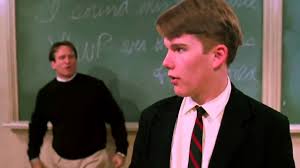
For many, however, it is Dead Poets Society (1989) which most effectively detailed how restrictive educational environments assault the souls of the students and their teacher. Ironically, particularly for this essay, Roger Ebert gave the film just two out of four stars.

Despite Ebert’s assessment, Dead Poets Society does allow the viewer to contact the pain of confinement and control that eventually consumed Neil Perry (played by Robert Leonard) as well as the slow climb to confidence experienced by Todd Anderson (Ethan Hawke). Anderson’s teacher, John Keating (Robin Williams), has a powerful live encounter with his student as, together, they step into the young man’s fear of inadequacy to pull forth his inner poet. While Ebert felt Williams was a bit too over the top in the role other viewers contend the flamboyant comedian embodied the artful teacher who utilizes the power of his discipline (English) to inspire his students to experience the power of words rather than striving to simply become an objective master of them.
The Power of Art
Ebert claimed, “When I go to a great movie I can live somebody else’s life for a while. I can walk in somebody else’s shoes.” This can happen for people even if they view a Roger Ebert two thumbs up movie like Dead Poets Society. The idea that movies, and by extension art, can widen and deepen our worlds was also promulgated by the NY Times article “The Mind-Expanding Value of Arts Education” (15). Professor Brian Kisidia shared, “People use the arts to offer a critical perspective of their exploration of the human condition, and that’s what the root of education is in some ways.”
The root of education being an exploration of the human condition. Part of a painstaking process of deepening the capacity to see the “other” as human and, by extension, deserving of certain considerations. Is that what schools do? Probably not, for as all highly qualified educators in the twenty-first century know, data driven decision making is needed to prove value and create budgets. Quantifying the value of art as a vehicle for the “exploration of the human condition” is quite difficult. Perhaps impossible. That’s what makes the exploration challenging and, perhaps, a bit frightening. It also makes the exploration glorious and invigorating. Could it be exactly what we are supposed to do but have simply forgotten?
Notes
1.Springsteen, B. (1984). No Surrender. Born in the U.S.A. New York, New York: Columbia Records.
2.https://www.rogerebert.com/roger-ebert/eberts-walk-of-fame-remarks
3. Calef, Scott. “A Little of that Human Touch: Knowledge and Empathy in the Music of Bruce Springsteen” from Auxier, Randall and Anderson, Dough (editors) Bruce Springsteen and Philosophy: Darkness of the Edge of Truth, (Chicago, Open Court, 2008), p. 225.
4. Hillman, James. The Soul’s Code: In Search of Character and Calling, (New York, Warner Books, 1996).
5. “Springsteen on Broadway” (Netflix, 2018).
6. Calef, Scott. “A Little of that Human Touch: Knowledge and Empathy in the Music of Bruce Springsteen” from Auxier, Randall and Anderson, Dough (editors) Bruce Springsteen and Philosophy, (Chicago, Open Court, 2008), p. 226-227.
7. Faber, Barry. Rock’n Roll Wisdom: What Psychologically Astute Lyrics Teach About Life and Love, (New York, Bloomsbury Publishing, 2007)
8. Calef, Scott. “A Little of that Human Touch: Knowledge and Empathy in the Music of Bruce Springsteen” from Auxier, Randall and Anderson, Dough (editors) Bruce Springsteen and Philosophy, (Chicago, Open Court, 2008), p. 228.
9. These questions are meant for to be personally evaluated. They should not be read as “leading questions.” I, for example, enjoy tremendous leeway at my school when it comes to films as I teach a class called P3: Philosophy, Psychology, and Pop-Culture.
10. Sergiovani, Thomas. Moral Leadership: Getting to the Heart of School Inprovement, (San Francisco, Jossey-Bass, 1992), p. 37.
11. ibid.
12. Palmer, Parker. The Courage to Teach, (San Francisco, Jossey-Bass, 1998). Palmer’s reflections on the “Culture of Fear” are found throughout chapter 2, pages 35-60.
13. ibid. Palmer speicifically introduces his list of teacher and student fears on page 37
14. ibid. pages 37-38
15. May 2, 2023 – https://www.nytimes.com/2023/05/02/arts/design/arts-education-necessary.html).
 james-rourke-author.com